

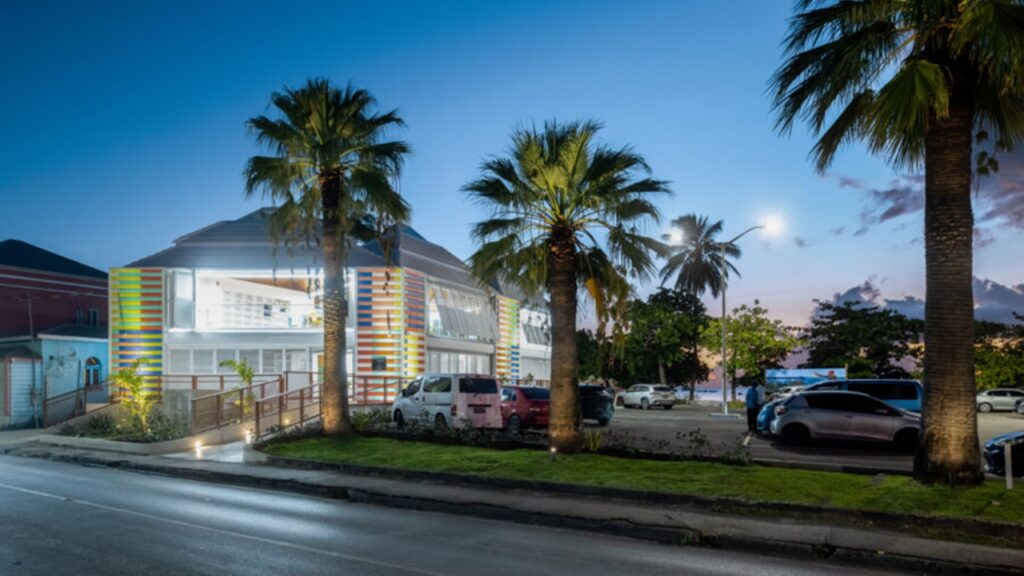
From a remote industrial warehouse in Madrid, a quiet revolution in architecture and education has culminated in the delivery of an “Apple-grade” school to the hurricane-hit coast of Barbados. The initiative is being spearheaded by Steve Jobs’s billionaire widow, Laurene Powell Jobs, founder of the Emerson Collective. The project officially opened its first structure, the Oceana Innovation Hub, in June 2025. The final nationwide benchmarks are expected to roll out early this year.
As climate change has become a major driver of economic crises, ventures that promote sustainability significantly shape how businesses approach the socio-economic issues that often hinder people’s endeavor to live a dignified life. Although CSR is a part and parcel of every business to contribute significantly to society, it is through projects like these that build not only the brand image but also make a positive impact on the world.
Laurene Powell Jobs leads sustainable school project in Barbados

According to the latest report by Luxury Launches, Laurene Powell Jobs is leading an important project pertaining to education and sustainability. The project is designed by Madrid-based company Ensamble Studio in collaboration with WoHo Systems. The school serves as a defiant rebuttal to traditional construction as it embodies a modern outlook while also catering for an important function besides its fundamental role as an educational institution. The campus is simultanesouly meant to serve as a shelter in the event of a hurricane.
The school facility in Barbados is comprised of prefabricated, mass-timber modules shaped into two-story equilateral triangles. These structures are engineered to be packed into standard shipping containers and assembled on simple flat slabs, allowing a $6 million climate-resilient school to quite literally “land on the sand” anywhere in the world.
The interior reflects a commitment to precision and purity. Eschewing the cluttered, rigid rows of traditional classrooms, the hub features open, double-height volumes filled with natural light from pyramidal skylights. The furniture is entirely “multi-postural” and triangular, allowing the space to flip from an intimate collaborative cluster to a high-tech presentation mode within minutes.
Much like the design logic of an iconic technology brand, there are no unnecessary ornaments; the beauty is found in the exposed mass-timber frames and the mathematical harmony of the space.
Related: Apple Accelerates CEO Succession Plan as Tim Cook Prepares to Step Down
Laurene Powell Jobs’s project could redefine global sustainability and philanthropy
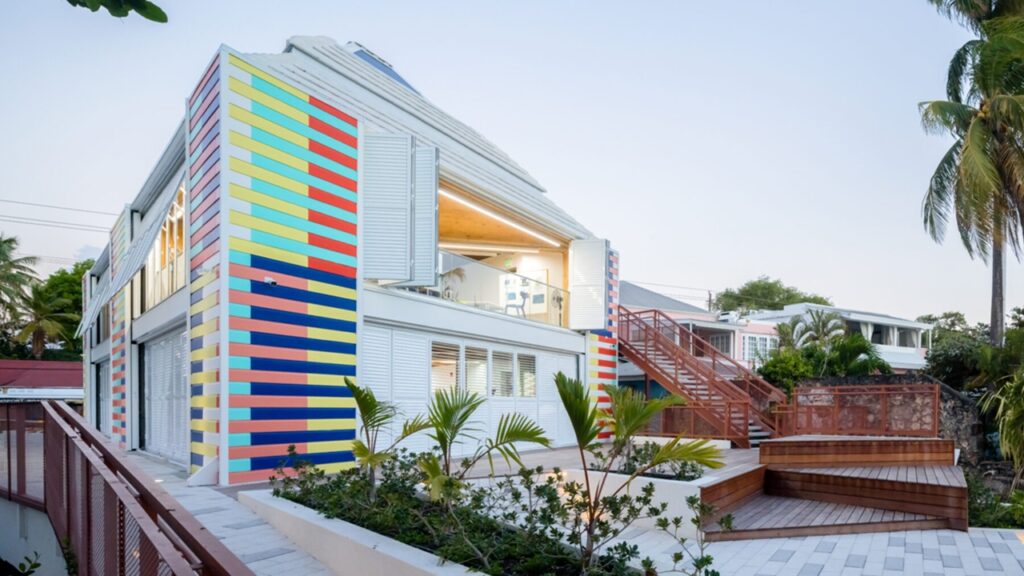
Beyond its aesthetic appeal, the Jobs’s school project is a powerhouse of self-sufficiency. It is zero-carbon, zero-energy, and entirely self-cooling. These are critical features for its location at Carlisle Bay. The steep pyramidal roof, inspired by the island’s traditional “chattel houses,” is engineered to shed hurricane-force winds. At the same time, the campus is capable of withstanding 100-year storms, thus providing a safe haven for the local community.
The Barbados project is merely the prototype for a global vision. As per the official website of the studio supporting the project, through XQ Institute that is chaired by Laurene Powell Jobs and Russlyn Ali, this three-campus system is intended to be a scalable model for the “hurricane belt” and other climate-vulnerable regions. By proving that high-end design can be modular, transportable, and sustainable, Powell Jobs is challenging the status quo of public infrastructure, ensuring that even in the face of environmental upheaval, the quality of a child’s education remains uncompromised.
Also Read: Donald Trump Suing JPMorgan for $5 Billion Could Lead to an Economic Disaster
