


In a watershed moment for the global equity markets, Walmart Inc. officially surpassed a $1 trillion market capitalization on Tuesday, February 3, 2026. This milestone represents more than a mere valuation peak; it signifies the definitive triumph of “omnichannel” retail over the purely digital insurgencies of the last decade.
By crossing this thirteen-figure threshold, the Arkansas-based titan has become the first traditional brick-and-mortar entity to join an elite fraternity of technology giants, including Apple, Microsoft, and Nvidia, effectively rewriting the narrative of the “old economy” in the process.
Walmart hits new milestone as retail giant attains $1 Trillion Market Cap
JUST IN: Walmart hits $1 trillion market cap
— Kalshi (@Kalshi) February 3, 2026
The surge in Walmart’s valuation follows a series of robust fiscal reports that have consistently outpaced analyst expectations. As reported by CNBC, the company’s share price ascended to record highs after investors responded favorably to a 27% year-over-year increase in e-commerce profitability.
This growth is not accidental; it is the culmination of a decade-long metamorphosis from a discount warehouse into a sophisticated data and logistics powerhouse. By leveraging its vast physical footprint, with stores located within ten miles of 90% of the U.S. population, as micro-fulfillment centers, Walmart has achieved a logistical synergy that even its most agile digital competitors struggle to replicate.
According to The New York Times, the crossing of the $1 trillion mark is a testament to Walmart’s successful courtship of a new demographic: the high-income consumer. Faced with persistent, albeit cooling, inflationary pressures, households earning over $100,000 annually have increasingly migrated to the aisles and digital platforms. The “trade-down” effect, once viewed as a temporary economic byproduct, has been solidified by the premiumization of the Walmart+ membership program and the expansion of an assortment of high-margin fashion and home goods.
Furthermore, the diversification of the retail giant’s revenue streams has been pivotal to this valuation milestone. Reuters highlights the exponential growth of “Walmart Connect,” the company’s retail media division. By monetizing its unparalleled first-party consumer data, the company has transformed into a formidable advertising platform, commanding margins far superior to those of traditional grocery retail. This high-margin income has provided the capital to fund aggressive investments in generative AI and autonomous supply-chain robotics, further insulating the company from labor-market volatility.
Related: Who Will Replace Retiring Walmart CEO Doug McMillon in 2026?
The CEO transition and Walmart’s growth
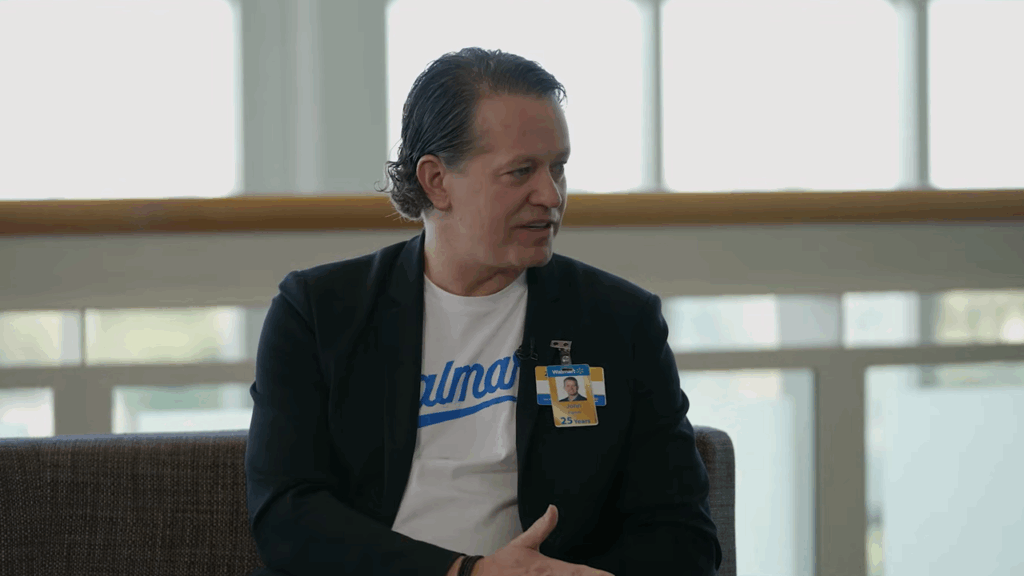
Forbes notes that, at the time of writing, Walmart is the 12th publicly traded company globally to reach this rarefied air. Perhaps most significantly, the achievement coincides with a historic leadership transition. As John Furner assumed the role of CEO earlier this month, the company signaled a future defined by “agentic commerce”—a system where AI-driven assistants anticipate and fulfill consumer needs before a conscious order is placed. This forward-looking posture has convinced Wall Street that Walmart is no longer a defensive value play, but a high-growth technology contender.
The implications of this $1 trillion valuation extend beyond the boardroom. It serves as a stark reminder of the enduring power of physical presence in an increasingly virtual world. As the retail brand integrates its sophisticated “Spark” AI into every facet of the customer journey, from predictive inventory to personalized digital storefronts, it has preserved the trust of its core value-seeking base while capturing the sophisticated urban market.
In the final analysis, Walmart’s entry into the trillion-dollar club marks the end of the era where “tech” and “retail” were viewed as distinct categories. In 2026, the world’s largest employer has proved that the most valuable commodity is not just data, but the infrastructure to deliver it to the doorstep. For the Walton family and the global investment community, the trillion-dollar mark is not a finish line, but the inaugural lap of a new retail epoch.
