

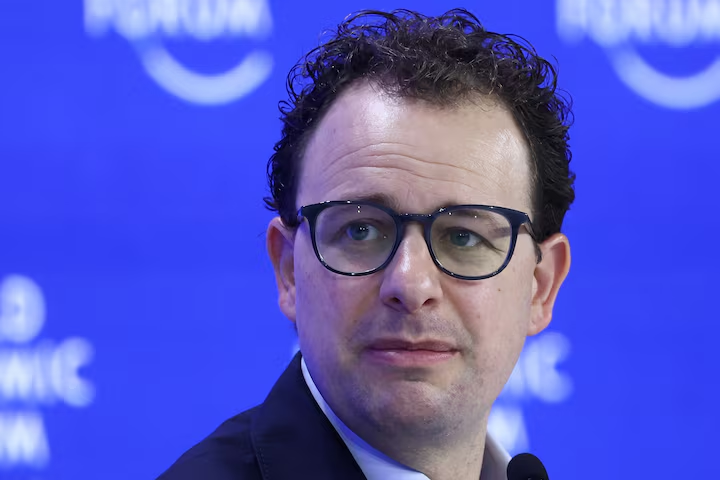
Anthropic CEO Dario Amodei, a key architect behind Claude AI, attended the AI builders’ summit in Bengaluru on February 16 and shared insights on how India is at the forefront of the AI race. Citing fast-moving government initiatives, “entrepreneurial energy”, and “technical acumen” in the country, Amodei predicted a bright future for India in the AI space. He also highlighted that the massive scale of the Indian market will be a key driver of AI innovation, enabling a rapid pace of experimentation—an advantage many other countries do not have.
Amodei’s comments come at a time when some of the world’s foremost AI leaders and policymakers are gathered at the India AI Impact Summit 2026 in New Delhi from February 16 to 20 to discuss artificial intelligence’s real-world impact, governance, and future opportunities.
Anthropic CEO highlights India’s strengths that could propel it into an AI powerhouse
“The ability for entrepreneurs and builders to learn quickly and fail fast here exceeds what we see in many other places,” Amodei said at the event. “That entrepreneurial energy and technical acumen really is unique here.”
“I was just hearing yesterday that the Ministry of Statistics is building an MCP (Model Context Protocol) server to query economic data and statistics. Generally speaking, government bodies elsewhere don’t move this fast and aren’t as up on things,” he added.
Pointing out that scale is a massive advantage for India, the Anthropic CEO said, “We can do experiments here with hundreds of millions of people. The pure scale allows us to learn things very quickly that you can’t do in smaller markets.”
Anthropic has set up its first office in Bengaluru, signalling its seriousness about expanding in the Indian market. The AI company is currently focused on supporting a wide range of Indian languages on Claude. The priority is AI training across regional languages, including Bengali, Marathi, Tamil, Telugu, Punjabi, Gujarati, Kannada, Malayalam, and Urdu.
The company also unveiled new partnerships with Indian organisations such as Karya and Collective Intelligence Project for local use cases in the domains of law and agriculture.
“One set that I’ve seen is around the large number of languages in India—building things that interoperate between those languages and make it easier to translate or be multilingual,” Amodei said at the summit.
Anthropic’s first office in India will be situated in Bengaluru’s Embassy Golf Links region. Later this week, Amodei, Anthropic CTO Rahul Patil, and other members of the company’s Indian contingent are expected to attend the India AI Impact Summit at Bharat Mandapam in New Delhi.
Sam Altman highlights India’s potential to become a “full-stack AI leader“

As competition to dominate the global artificial intelligence market heats up, Altman is betting that India will emerge as the next AI powerhouse. He was quoted by Indian publications ahead of the summit as saying the country could become a “full-stack AI leader,” citing its homegrown tech talent and the need for a national strategy to drive widespread adoption.
Altman also pledged support for India’s development of cutting-edge AI systems and expressed confidence in the nation’s ability to help shape AI’s future.
Like Amodei, Altman pointed to India’s scale as a key advantage driving AI innovation. “As of this month, India has 100 million weekly active users, giving it the second-largest user base globally after the US. It has the largest number of students on ChatGPT worldwide, showing how many young people here are using AI to learn faster and get ahead,” he said, adding that India also ranks among the top global users of OpenAI’s new research tools.
Altman further praised the Indian government’s IndiaAI Mission, aimed at “expanding compute capacity, supporting startups, and accelerating multilingual applications that improve public service delivery, including in healthcare and agriculture.”
The ongoing India AI Impact Summit 2026 is expected to play a key role as India and global AI leaders chart a roadmap for investment, innovation, and technological progress that could benefit the world at large.
Also Read: Sam Altman Opens Up About Balancing the Pressure of OpenAI With Family Life
