


In a historic shift for South American politics, the reported capture of Nicolás Maduro has sparked both a rare domestic military spectacle and a wave of profound uncertainty for the Venezuelan people. Over the past week, the sights and sounds of this geopolitical drama have reached as far as Los Angeles, where the presence of the U.S. Air Force’s “Doomsday” plane, also known as the E-4B Nightwatch, served as a jarring, high-altitude reminder of the gravity of the situation.
The silhouette of the “Doomsday” plane over California is more than a display of military might; it is a symbol of how quickly a local crisis can become a global priority. Behind the secure communications and strategic strikes are millions of people waiting to see if this moment will lead to a genuine democratic transition or simply a new chapter of unrest. As legal proceedings begin in Manhattan, the real story continues to be written in the streets of Caracas, where a nation is collectively holding its breath for what comes next.
The Doomsday plane spotted in the skies of Los Angeles

As per a recent report by Daily Mail, the US “Doomsday” plane was recently spotted in the skies. Beyond the immediate political theater, the E-4B Nightwatch represents a formidable legacy of Cold War engineering and strategic continuity. Originally developed in the 1970s as a survival measure for the U.S. government, this “flying Pentagon” is a heavily modified Boeing 747-200 designed to remain airborne for several days through aerial refueling.
Technically, the aircraft is a marvel of resilience; its aluminum skin and internal systems are shielded against the electromagnetic pulse (EMP) of a nuclear blast, and it features a distinctive “radome” on its upper deck that houses a massive satellite antenna. This hardware allows the President and the Secretary of Defense to maintain secure, global communications with the nation’s nuclear triad and ground forces even if land-based infrastructure is decimated. Only four such aircraft exist, and their deployment typically signals that the American chain of command is operating at its highest level of readiness.
Related: Bill Gates’ Latest $8 Billion Payment to Ex-Wife Shows Why Prenups Matter Even for Billionaires
The Doomsday sighting and the Venezuelan connection
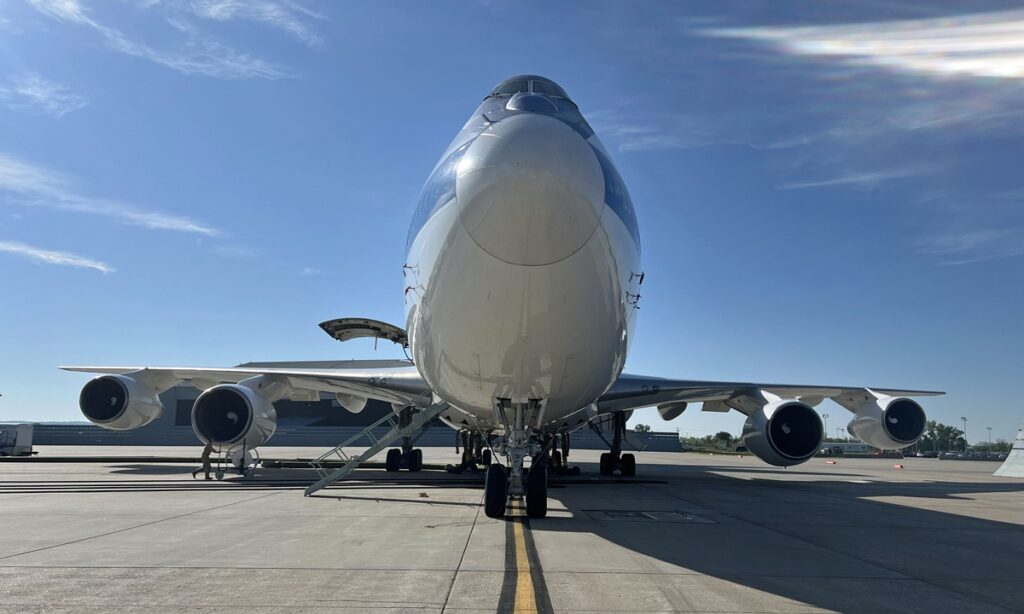
The aircraft’s appearance at LAX, carrying high-ranking officials such as Secretary of Defense Pete Hegseth, was an unusual sight for a civilian airport, marking the first time the public captured it at a major commercial hub in over 50 years. While defense officials described the stop as part of a routine “Arsenal of Freedom” tour, the timing was impossible to ignore.
Arriving just days after the January 3 “Operation Absolute Resolve,” the plane functioned as a mobile nerve center while the world processed the logistical and diplomatic fallout of Maduro’s extraction from Caracas. For many watching the silhouette of the massive jet against the California coast, it wasn’t just a plane; it was a visible sign that the stakes had reached a global tipping point.
The international community remains deeply divided over the raid’s implications. For many Venezuelans, the capture represents the potential end of a decade-long era of economic collapse and political repression—a chance to finally “get their lives back.” However, the sight of foreign military intervention on sovereign soil also brings a different kind of fear: the concern over prolonged instability or the reality of being “run” by a foreign power. President Trump’s recent remarks regarding the country’s administration and its oil resources have only added to the complexity of the narrative.
