

In a departure from the high-octane theatrics typically associated with automotive launches, Ferrari has unveiled the first definitive glimpse into its electric future. Rather than showcasing aerodynamic silhouettes or unprecedented battery metrics, the storied Italian marque has chosen to lead with the interior of its first fully electric vehicle: the Ferrari Luce.
The unveil marks a historic collaboration between Ferrari’s design leadership and LoveFrom, the creative collective founded by former Apple designers Sir Jony Ive and Marc Newson. The result is a cabin that serves as a profound rejection of the “screen-heavy” excess currently dominating the luxury EV sector, favoring instead a philosophy of permanence, tactility, and “analogue restraint.”
Ferrari steps into the EV industry with Luce
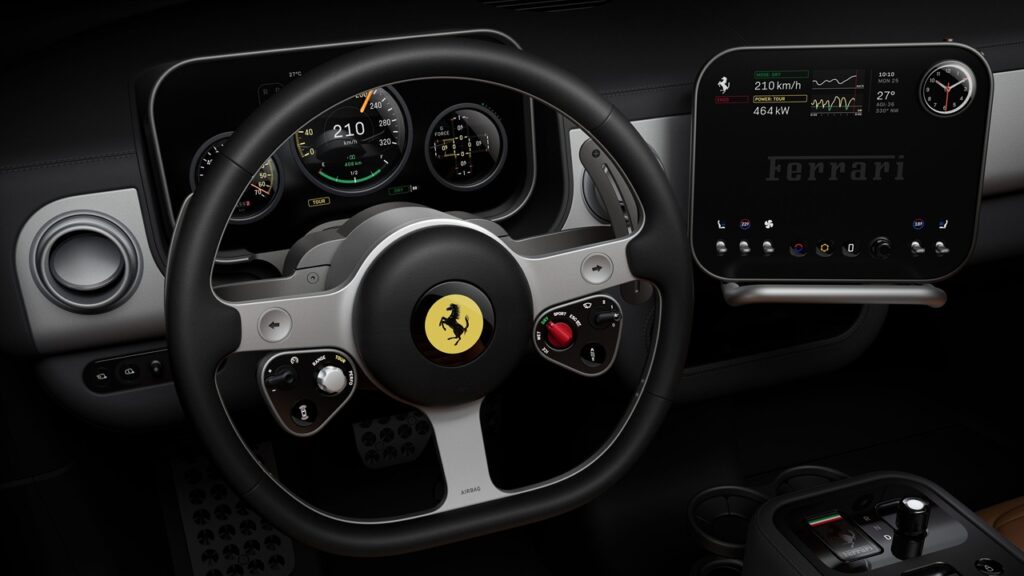
According to a recent Luxury Launches report, Ferrari’s presentation of the Luce’s interior was notably fragmented, treating each component as a suspended “workstation” rather than mere decorative trim. From the steering wheel to the air vents, every element was engineered with the intensity usually reserved for a hero product. This approach ensures that the cabin feels less like a software wrapper and more like a cohesive collection of finely tuned instruments.
At the heart of this experience is the instrument binnacle, developed in partnership with Samsung. Distancing itself from the flat, tablet-style dashboards of its peers, the Luce utilizes a layered OLED system featuring three circular dials. The front layer is defined by anodized aluminum rings and parabolic lenses with precisely cut apertures, while a physical aluminum needle runs between the layers. Backlit by a ring of LEDs, the system creates genuine visual depth and parallax, allowing the driver’s eyes to anchor on familiar mechanical forms while retaining digital flexibility.
The driver’s interface is anchored by a three-spoke steering wheel inspired by the Ferraris of the 1950s—a design personally championed by Piero Ferrari. Milled from 19 recycled aluminum billet components and wrapped in leather, the structure is ultra-thin and weighs approximately 400 grams less than a standard Ferrari wheel. In a significant ergonomic shift, the instrument cluster is mounted directly to the steering column, ensuring the gauges move in unison with the driver’s rake and reach adjustments.
Physicality dominates the cockpit’s utility. Two manettino-style rotary pods manage powertrain and chassis modes, each uniquely shaped for tactile identification. Essential functions—indicators, wipers, and climate control—are handled via aluminum toggle switches and tuned buttons. Beneath the central screen, a machined handle doubles as a palm rest, facilitating precise interaction with the interface without the awkwardness of reaching toward a vibrating dashboard.
The influence of the LoveFrom DNA is evident in the material palette, which leans heavily on anodized aluminum and Corning Fusion glass, specifically engineered for automotive crash safety. The center console features a semi-matte surface where 13,000 laser-drilled micro-holes, filled with ink, form illuminated graphics that are resistant to fingerprints.
Ferrari Luce to enhance driver’s experience

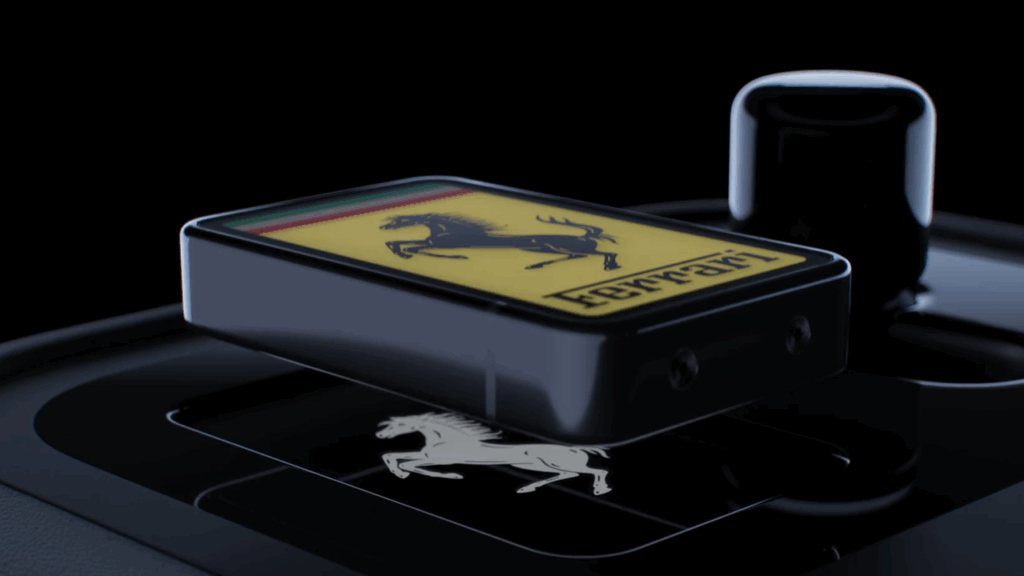
The Luce also reintroduces a sense of ritual to the driving experience. The vehicle’s key is a slab of glass and aluminum with an embedded E-Ink display. When docked, the yellow Cavallino appears to “drain” into the shifter as the key turns black—a mechanical theater achieved through light rather than animation. To initiate performance sequences, a milled aluminum launch-control handle drops from the ceiling, evoking an avionic undertone.
Sir Jony Ive described the project as an effort to create an interface that is “physical and engaging,” treating every component with the reverence usually reserved for a high-end camera or a watch. By utilizing a bespoke typeface, LoveFrom Maranello, which draws from the Veglia and Jaeger gauges of the 1960s, the Luce successfully bridges the gap between heritage and the electric age.
As the industry grapples with touch-sensitive interfaces that often frustrate users, Ferrari’s Luce represents a decisive course correction. By prioritizing depth, tactility, and human-centric design, Ferrari suggests that the electric future need not be ephemeral, but can instead be something unmistakably enduring.
Also Read: Exploring $115 Billion Worth Bill Gates’ Luxurious Car Collection
